Critics - ENDLESS COUPLING 2024
|
|
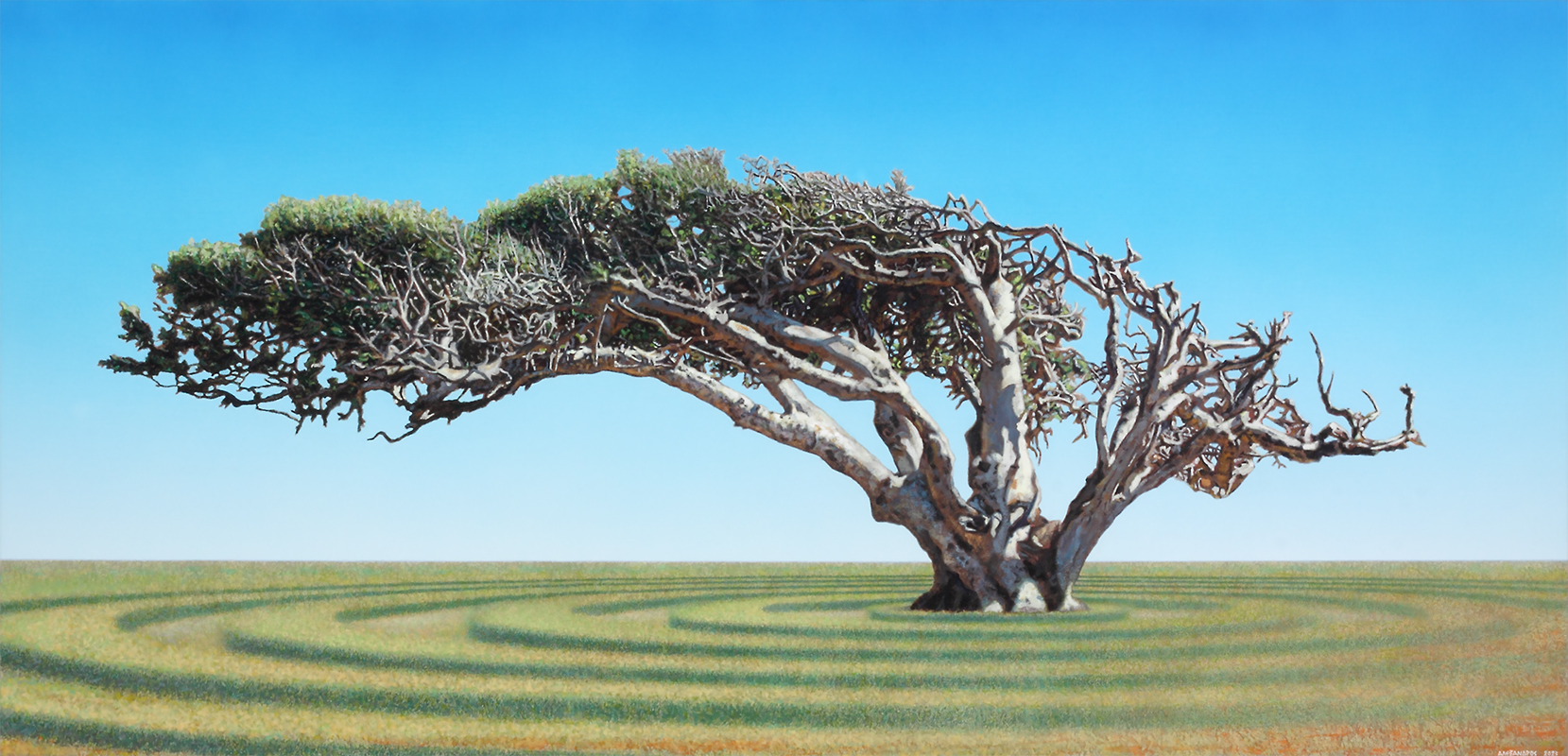
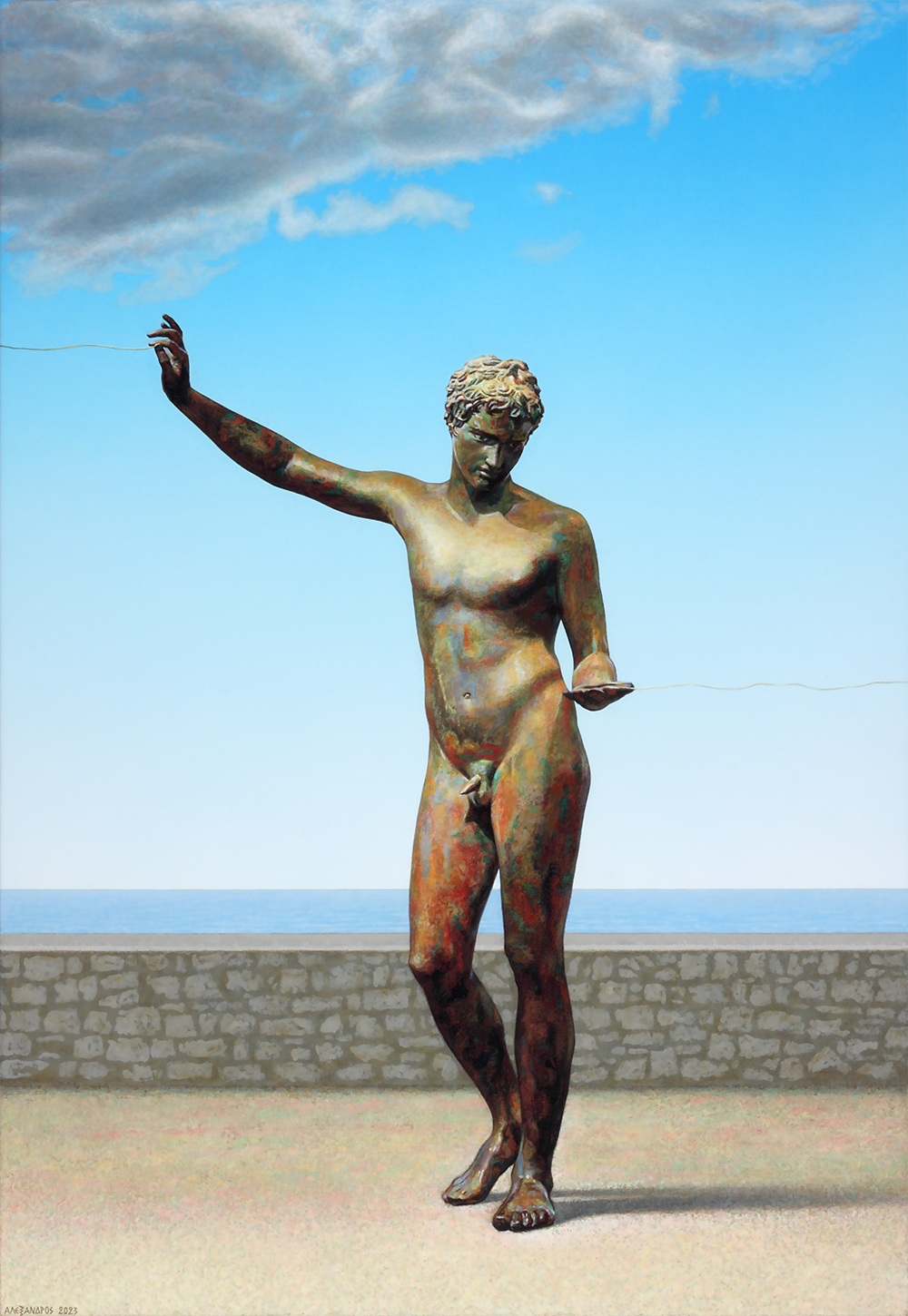
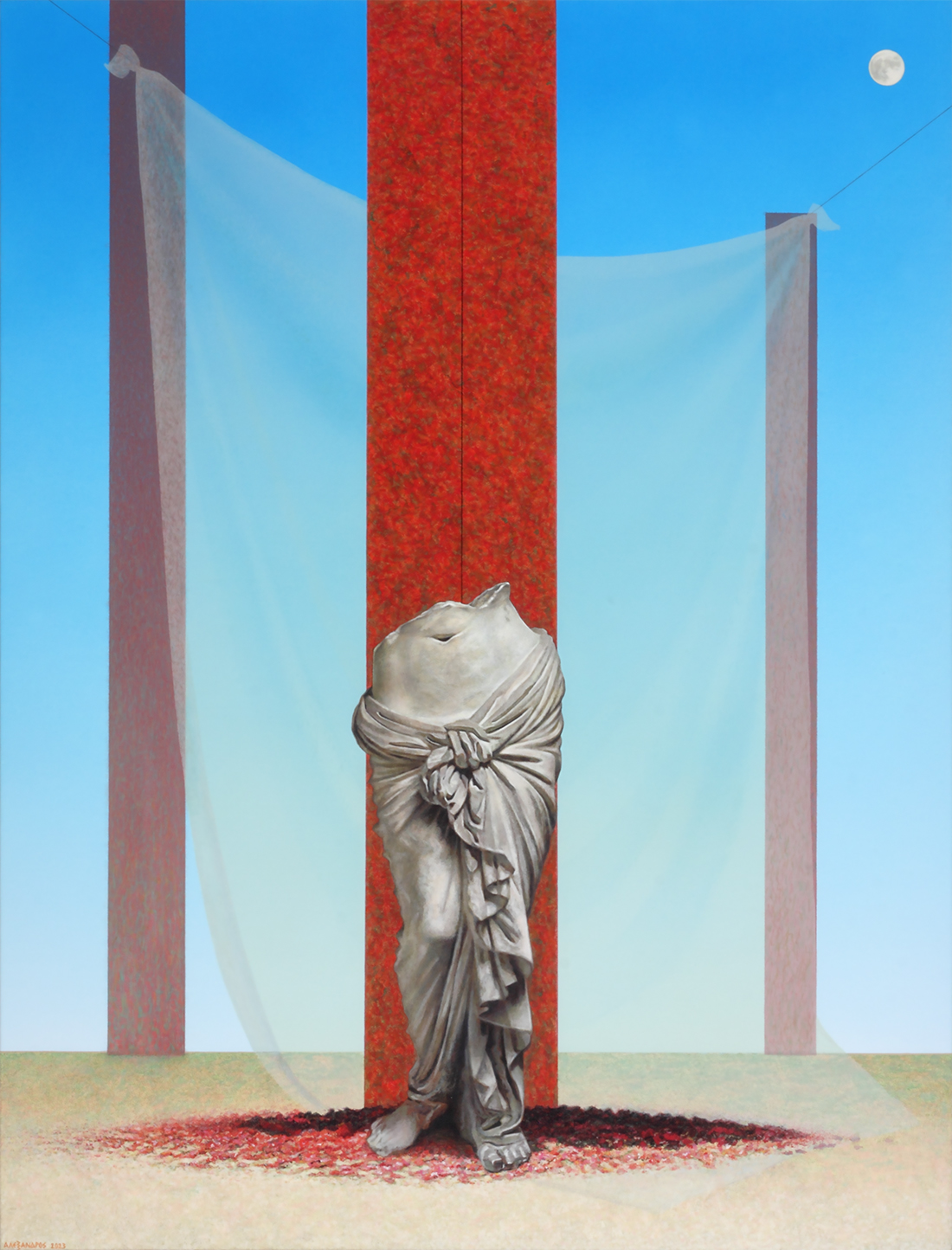
Simulation Experiences Alexandros Moustakas is a contemporary painter of digital post-modern neoclassicism. His paintings are contemplative, imbued with a sense of otherworldly calm, introspection, and fragile balance. By frequently incorporating monumental symbolism, he creates a distinctive dialogue between classical antiquity and modern psychology, reshaping references to Greco-Roman art into conceptual elements of his painting rather than nostalgic recollections. This allows him to critique the way the past is received in today's fragmented, digitized cultural landscape. He first appeared with the series My Trains (Agathi Gallery, 1998), where he worked on themes of abandonment, nostalgia, and industrial decline. This was followed by the series Place (Ersi's Gallery, 2001), with minimalist and conceptual depictions of environmental decay in abandoned industrial spaces, and in later exhibitions, Awakening (Kapopoulos Fine Arts, Golden Hall, 2011) and Alexander, Gordian Knot (Argo Gallery, 2017). Inspired by the delicate balance between nature and history, he focused on themes of peaceful euphoria and optimism. In his recent body of work titled Endless Coupling (Argo Gallery, 2024), Alexandros delves into the simulation of human experience. The idealized and seemingly flawless versions of life portrayed in his works merge reality with imagination in our digitized world, where human behavior and knowledge are filtered through virtual environments. From this mixture of worlds, he draws material from ancient art, such as the Antikythera Youth (340--330 BC), the Sandal-Binding Nike (420--400 BC), Apollo Sauroktonos, Aphrodite Crouching, and the busts of Alexander, composing contemporary visual narratives that explore the human condition, mythology, and cosmic forces. His unpredictable subject matter is enigmatic, and its meaning often ambiguous, as he shifts from physical to psychological spaces reflecting the tension between classical ideals and postmodern fragmentation. The fragile nature of human existence is captured in Balance (2019), where an androgynous armless figure leans precariously forward, held up only by a thin thread descending from the sky. This posture highlights the delicate equilibrium between control and vulnerability. It also represents a deconstruction of classical idealism when viewed through the lens of today's existential anxieties. Alexandros often uses gardens as metaphors for the search for self-knowledge, showing how the quest for inner truth can also trigger feelings of alienation. The entry of a bronze statue into The Secret Garden (2019) is strewn with rose petals, while in The Garden (2021), the fenced-in area restricts and isolates. One canvas suggests a virtual paradise through an open gate, while the other presents a claustrophobic space---beautiful and manicured, but with no way out. By redefining the classical garden as a psychological landscape, Alexandros delves into the complexity of the modern mind, implying that the search for meaning often carries the risk of self-destruction. Compared to the timeless serenity of Giorgio de Chirico's enigmatic environments or Paul Delvaux's nostalgic dreamscapes, Alexandros' gardens convey a vivid atmosphere between tranquility and confinement. While De Chirico and Delvaux engage with spiritual nostalgia, Alexandros emphasizes psychological complexity, turning his gardens into sites of contemporary consciousness. Moustakas' work also moves between the physical and the metaphysical, weaving personal introspection with cosmic themes, as seen in Hyperion (2019), Genesis (2019), Cosmogony (2021), Metamorphosis (2022), Memory (2023), Aphrodite (2023). Mythological references to Hyperion and Aphrodite connect individual journeys with broader cosmic and archetypal forces, influenced by Carl Jung's theories on the collective unconscious (Four Archetypes: Mother, Rebirth, Spirit, Trickster, Iamblichus 1995). For example, in Hyperion, the expected Titan of light (the Homeric Sun) and celestial order is replaced by a minimalist scene dominated by a towering cypress tree symbolizing transcendence and divine perspective. In his depiction of Aphrodite, Alexandros questions enduring ideals of beauty and identity, aligning himself with feminist critiques such as Luce Irigaray's This Sex Which Is Not One (1985). Irigaray, challenging the way femininity and beauty are constructed in patriarchal society, argued for a new language and new representations of women rooted in their own experiences, outside the boundaries of male-dominated discourse. The dualities of memory and transformation hold a central place in Alexandros' themes, especially in Memory (2023) and Metamorphosis (2022). In Memory, a monumental weathered bronze hand emerges from a minimalist solid structure, symbolizing the endurance of human creativity and cultural memory: despite the erosion of time, the essence of memory remains intact. Conversely, in Metamorphosis, the broken marble head of the crouching Aphrodite meets an elongated cloud, alluding to the fluidity of self-perception. If the cloud represents the ongoing state of transformation, the fractured head of Aphrodite embodies the ephemeral nature of identity. This juxtaposition suggests the ambiguity of change---both destructive and regenerative. The vertical strip resembling a carpet of red and green flowers, along with scattered petals on the ground, acts as an allegory of decay and renewal, reinforcing psychological transformation. Moustakas' postmodern neoclassicism condenses the psychological complexity of contemporary life by critically reshaping classical art while confronting digital challenges. Deconstructing timeless forms, Alexandros does not treat antiquity as a relic; instead, he reframes it as a dynamic element in the dialogue that shapes today's perception of identity and society. This approach is evident in Gate in Rust (2024), where a steel structure disintegrating in a barren landscape becomes a symbol of human resilience against the corrosive forces of time. As Umberto Eco argues in Travels in HyperReality (1990), simulations often become more fascinating than their originals. Alexandros' art visualizes this idea, constructing a pictorial hyper-real psychological space where reality merges with illusion. In this environment, the modern individual sees reflections of themselves in the virtual world of antiquity, enabling a re-evaluation of both past and present. Ultimately, as art history has shown, painting transcends simple depiction and functions as a "multicolored couch of self-knowledge," replacing the traditional couch of the psychoanalyst. For Jacques Lacan, as articulated in The Mirror Stage as Formative of the I Function (Écrits, 1949), it is the artist who lies on this couch, while for John Berger in Ways of Seeing (1972), it is the viewer who interprets the work. This interplay highlights that both artist and viewer participate in active interpretation and share common experiences that transform viewing into a catalyst for introspection---a notion developed by Maurice Merleau-Ponty in Phenomenology of Perception (1945). In an era defined by digital saturation and rapid cultural change, the art of Alexandros Moustakas illuminates these transformative processes of contemporary individual and collective consciousness. |
|
|
Kolokotronis Giannis
|