Critics - GORDIAN KNOT 2017
|
|
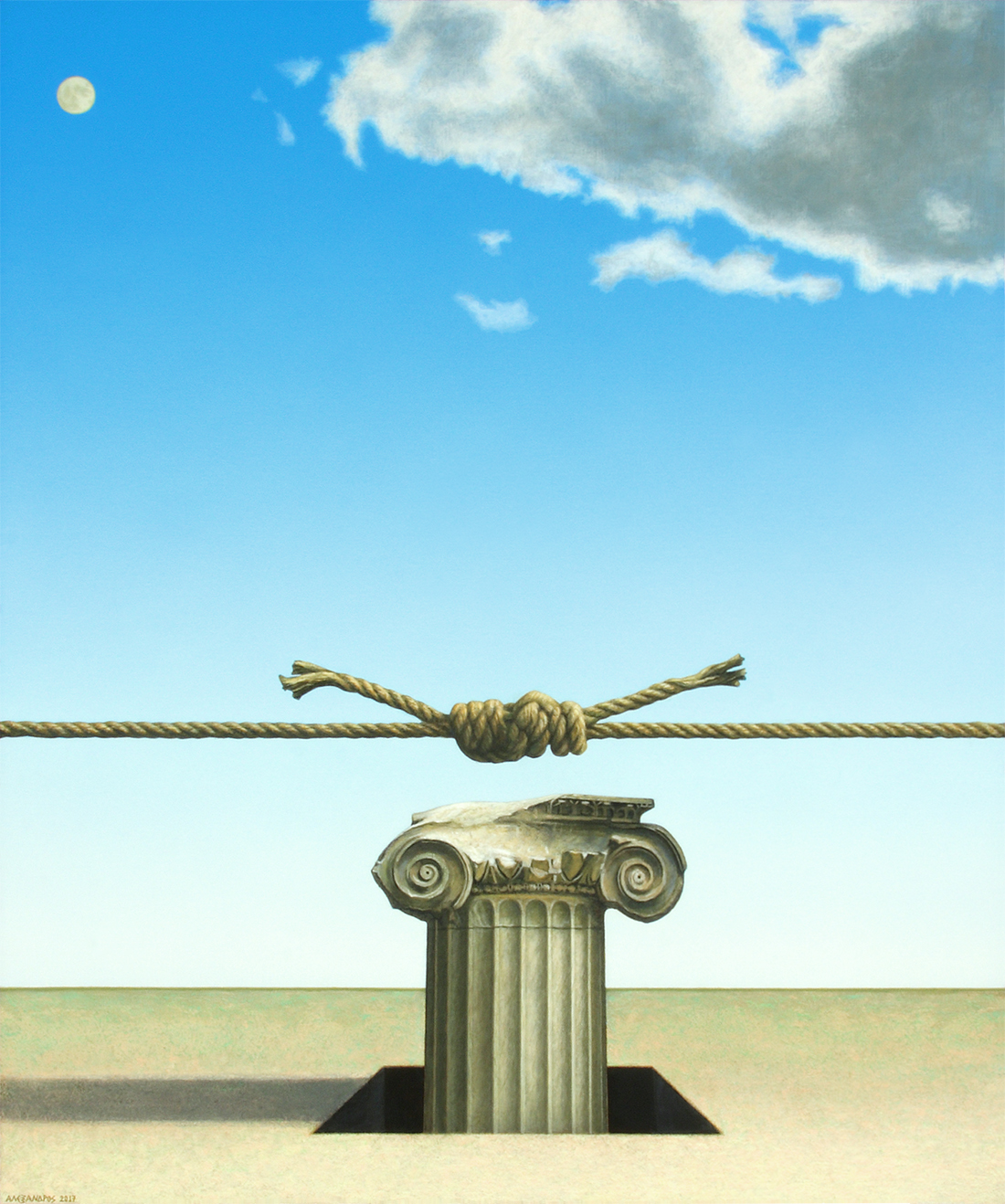
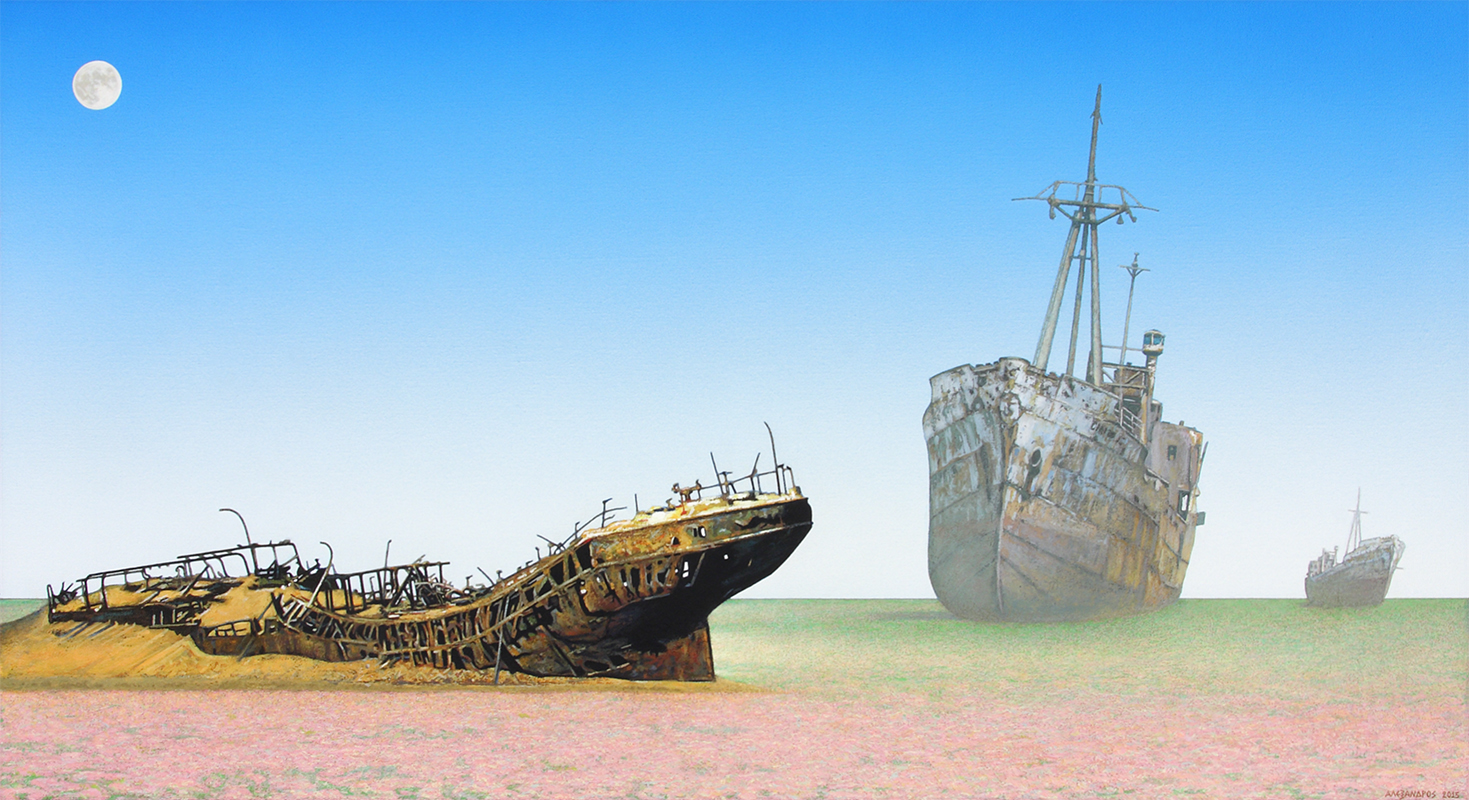
Alexandros Paints the Gordian Knots of Our Time I hasten to say it from the beginning, without leaving it for a conclusion: Alexandros' painting does not leave you indifferent. Out of curiosity, interest, or puzzlement, you search to discover what he wishes to say. And even if you do not find it, if you get entangled in multiple interpretations, if the question indeed remains unanswered, what matters is that his painting raises issues that place the viewer in a state of constant search, while at the same time delighting and engaging the eye. His painting attracts, it urges the viewer to perceive it. It is not passive, nor merely decorative---it has direction and intent. The subjects provoke both visual and intellectual stimuli; nothing comes pre-digested. His compositions carry visual balance, beauty, and grace; he does not deny these dimensions simply because he seeks to address problems. His technique impresses with the perfectionism the painter has exhausted in order to convey what he wishes to suggest. All these elements together form his artistic style. Realistic representation is his chosen path, through which he combines the old formulation with solid results of a contemporary form and perception. It is painting with personality, projecting the creator's own identity. The sources of Alexandros' inspiration are evident. He is a young man in his maturity, living, like all young people today, in an ambiguous age marked by technological euphoria and the constantly renewed elements of an informational revolution. Knowledge of problems at home and across the globe is delivered to us through immediate communication and continuous updates, every hour, every moment. Correct, democratic, objective information bears no blame. The opposite kind is part of the problem. It is now a common realization that young people, above all, face impasses resulting from mismanagement and the inhuman behavior of their elders. The societies in which they live are responsible---some more, some less. These are impasses of many forms, creating a harsh reality. Within this Alexandros moves and from this he draws his subjects, with thought and imagination, to create his works with purely artistic means. What is absent is pomp, rhetoric, ex cathedra denunciation, or anything inappropriate. Instead, what dominates is simplicity, symbolism, subtle suggestion, a power of evocation. In the work Dream, he painted in the foreground, slightly to the right of the center, a little paper boat---like those we made as children, like the one that revived memories during the temporary pond at the opening ceremony of the Athens 2004 Olympic Games. Its age refers unambiguously to a symbol of childhood innocence. Yet the painter discreetly filled the sky, instead of clouds, with transparent panes of glass arranged in triangular formations, their sharp corners conveying a sense of aggression, without diminishing the high aesthetic value of the whole. Another element of the painter's artistic intentions may perhaps be conveyed here verbally, in the absence of visual proof. The upper part of a Corinthian column emerges from a small squared depth, as if functioning as an ancient Greek altar. A little above hovers the knot of a taut rope, seemingly ready to snap. Nothing else. The title of the work may explain the meaning of the composition. The knot needs to be cut, dissolved, abolished, so as to neutralize the tension. To be sacrificed upon an altar of breath and vindication, like the edifice of ancient Greek values. The title is eloquent: Gordian Knot. Thus he named the entire exhibition. A visual creation that exudes, with simple and spare means, poetry and light, visual joy and clarity. A beloved symbol in Alexandros' painting is the dove---with all it carries upon its wings: innocence, peace, fortune's favor, joy, love, humility, the airy grace of presence, freshness, solitude, the embrace of the earth by a flight from heaven. At times he makes it bow, hide, signify respect---and even shame. The reference is multivalent, the allusion multifaceted. Alexandros has leaned upon this timeless symbol in a way that his painting has fallen in love with it. He achieves this in countless variations, and with a visual rendering that invites touch, as does good sculpture. Not rarely he too gives the dove a relief-like presence, as he does with selected elements in other works, where he wishes to emphasize their importance. He accomplishes this with the imperceptible means of his own technique. Hints of surrealism appear, concepts that touch vision, dream, inner desire, the metaphysical. In his work The First Touch, the dove, just as it reaches with its feet to graze the trembling surface of the sea, creates concentric ripples of water which spread outward like transmitters. The natural phenomenon, yet perhaps also the metaphysical message, is what he wishes to convey. The outcome of the transmitter's intervention arises without pomp, and it is complete: a visual delight, serenity, and affirmation. Symbols abound in Alexandros' painting, in which other conditions are easily traced: the rotten ship, rust, the ear of wheat, cracks, the split pomegranate evoking the notion of sacrifice, a red line, a ribbon. Alone, or "together with many," they yield luminous combinations where Mediterranean blue dominates, the clarity of line, the pure color, the studied composition---all nourishment for the eyes and at the same time a music that soothes the hearing. Stimuli that cannot be faced with indifference. They push toward searching, toward investigation, because, in the end, Alexandros' painting hides enigmas---not riddles like those of the Sphinx, but with analysis, resolution, and perhaps a liberating conclusion. |
|
|
Kostas Serezis |